


Nursing home care costs can drain a lifetime of savings in just a few years. Holding onto your family home or leaving a legacy to your loved ones requires careful planning. If you’re preparing to apply for Medicaid to cover long-term care costs, it’s important to understand how the look-back period affects eligibility.
This guide explains the difference between proactive planning and crisis management, how Medicaid look-back penalties work, and how to protect your assets while ensuring you can enjoy quality care as long as you need it.
At a glance:
- The look-back period matters: Medicaid reviews 60 months of financial transactions before approving nursing home coverage. Transfers made during this window can trigger penalty periods and affect eligibility.
- Proactive planning wins: Planning five or more years ahead gives you maximum control and complete asset protection through Medicaid Asset Protection Trusts (MAPTs).
- Crisis planning still helps: Even if you need care on shorter notice, strategies are available to protect a significant portion of your assets.
- Timing is everything: The earlier you plan, the more options you have and the more you can protect.
What Is the Medicaid Look-Back Period?
As of 2026, to qualify for nursing home Medicaid coverage in New York, you can have no more than $33,038 in countable assets — bank accounts, investments and additional real estate beyond your primary home.
The look-back period is a 60-month review window intended to prevent people from giving away assets right before applying for Medicaid benefits. Medicaid examines your financial transactions for the past five years when deciding whether you are eligible for nursing home Medicaid coverage. The examination covers:
- Bank and brokerage statements: Withdrawals and transfers
- Real estate deeds: Property transfers to family members
- Gift documentation: Money or assets given to children or grandchildren
- Trust documents: Asset movements into or out of trusts
- Loan forgiveness: Any debts you canceled for family members
If Medicaid finds assets given away for less than fair market value during this window, you face periods of ineligibility, but transactions before the 60-month window are not penalized. That’s where proactive planning can help you.
How Are Medicaid Penalties Calculated?
When Medicaid finds a disqualifying asset transfer, they impose a penalty period. This period is the number of months you must wait before you can successfully apply for Medicaid to cover care, even if you are otherwise eligible. The calculation is: Total value of improper transfers / regional penalty divisor = your penalty period in months.
For 2026, New York City uses $15,282 per month as the regional penalty divisor. For example, if a New York City resident gifted $152,820 to their child in January 2025, and then applied for Medicaid in March 2026, the penalty would be calculated as $152,820 / $15,282 = a 10-month penalty period. In this scenario, the person is excluded from Medicaid coverage for 10 months. The family would have to pay $15,282 monthly out of pocket, totaling $152,820, before Medicaid starts to pay (if they reapply successfully after the penalty period).
Planning to Protect Your Assets
Planning for nursing home Medicaid coverage means taking action more than five years before needing care. By being proactive, you’ll have maximum control and the best outcomes for protecting your family’s wealth.
Why Planning Ahead Is Crucial
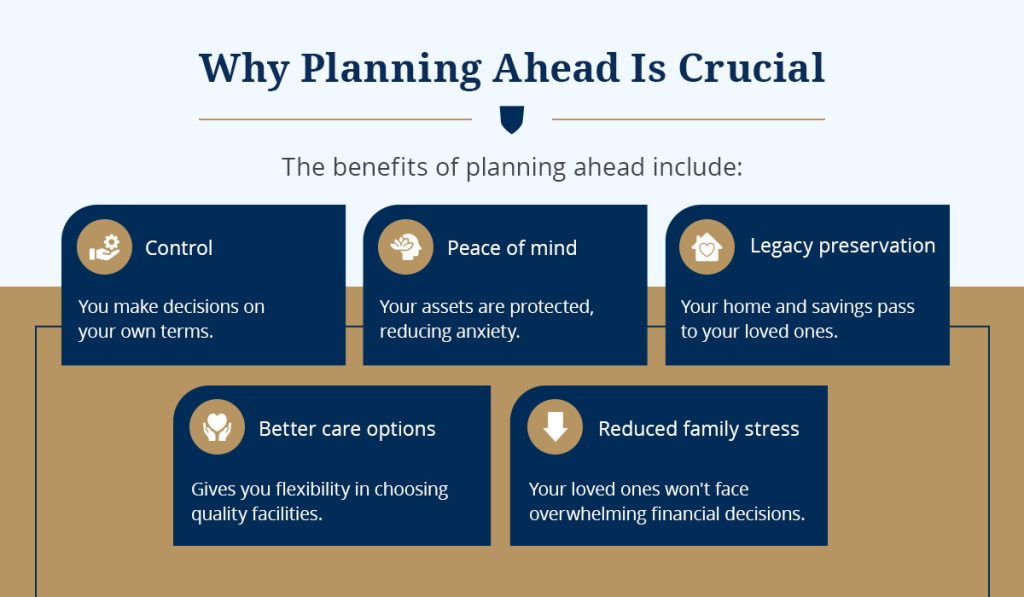
Planning while you’re still healthy allows you to organize assets without urgent pressure. The benefits of planning ahead include:
- Control: You make decisions on your own terms.
- Peace of mind: Your assets are protected, reducing anxiety about the future.
- Legacy preservation: Your home and savings pass to your loved ones.
- Better care options: Preserving your assets gives you flexibility in choosing quality facilities.
- Reduced family stress: Your loved ones won’t face overwhelming financial decisions during medical emergencies.
Preserving Wealth With an MAPT
An MAPT is the primary solution for Medicaid planning. You transfer assets like your home, investments or savings into a specialized, Medicaid-compliant irrevocable trust. After 60 months, those assets are no longer countable for Medicaid purposes and won’t trigger any penalties. Because you don’t legally own them anymore — the trust does — Medicaid can’t count them to determine your eligibility.
When you transfer assets into an MAPT, you retain:
- Income rights: You can still benefit from interest, dividends and rental income generated by trust assets.
- Right to reside: You have the right to live in your home for life if transferred into the trust.
- Beneficiary changes: You can change who ultimately receives the assets, depending on the terms.
At the same time, you can no longer withdraw the underlying asset value or sell assets and pocket the money. You may, however, gift any money from the trust to your beneficiaries. Although the trust is irrevocable by you, in New York it may be revoked if all parties (you and your children) sign.
Someone other than yourself must serve as the trustee, often an adult child or professional. Properly drafted MAPTs offer an important tax advantage. When your children eventually sell assets they inherited through the trust, they avoid paying capital gains taxes on the appreciation that occurred during your lifetime. If you simply gift your home to your children now, they’ll inherit your original purchase price and face a large tax bill based on the appreciation when they sell.
MAPT vs. Other Strategies
Some families consider alternative strategies for proactive Medicaid planning, but these approaches have significant downsides. For example, joint asset ownership with children leaves assets vulnerable to children’s lawsuits or divorces. It also results in unfavorable tax treatment. When you add a child to your deed, they receive the home’s original purchase price on their share (carryover basis) rather than the stepped-up value at your death. They will pay higher capital gains taxes when they eventually sell. Additionally, adding someone to your property title requires gift tax reporting to the IRS.
An MAPT protects assets from creditors and lawsuits, preserves tax benefits, maintains flexibility to change beneficiaries depending on terms, and can protect multiple asset types under one structure.
What to Do If You’re in a Crisis
Crisis planning happens after a stroke, fall or dementia diagnosis when immediate care is needed. Options are limited, and outcomes may be less favorable. Still, if you or someone you love needs immediate nursing home care, you have strategies to consider. Common crisis strategies include:
- Gift and loan: In this strategy, you gift half your assets to your children and loan the other half to them with a promissory note. The loan payments provide an income stream to help cover care costs during the penalty period and they get to keep the gift of half.
- Spousal refusal: The healthy spouse transfers assets into their name, then signs a refusal form stating they won’t contribute to the ill spouse’s care. Medicaid generally cannot deny the ill spouse care based on spousal refusal in New York, Florida, Ohio or Rhode Island. The state can later pursue reimbursement, so planning with an attorney remains important, as these cases can be negotiated down.
- Medicaid annuities: You can convert a lump sum of money into guaranteed monthly payments. Because Medicaid treats monthly income differently from cash assets, this approach can help you qualify for coverage while still maintaining income to help pay for care. Note that the state receives the remaining value if you die before the annuity is paid back in full.
- Personal care agreements: If you have family members helping with daily care, you can formalize the arrangement through a written contract and pay them fair market rates to reduce your assets without penalty.
An elder law and Medicaid attorney can help you choose the best strategies available in your case to secure eligibility, avoid or minimize penalties, and protect your family’s wealth.
Take Control of Your Future With Ettinger Law Firm
When you understand the Medicaid look-back period, you can choose the best strategies available to secure your family’s future. Whether you’re planning ahead or making urgent care decisions, a seasoned elder law attorney can help you navigate Medicaid eligibility and protect your assets.
Ettinger Law Firm has over 35 years of experience and has successfully filed over 5,000 Medicaid applications. We understand the challenges New York families face when confronting long-term care costs. We can help you create a customized plan, using the MAPT and other asset preservation solutions to give you the peace of mind you deserve.
Request a free consultation online or call us at 1-800-500-2525 today to discuss your legal resources for long-term care costs.